
How Online Reviews Influence Local Search Rankings and Customer Trust
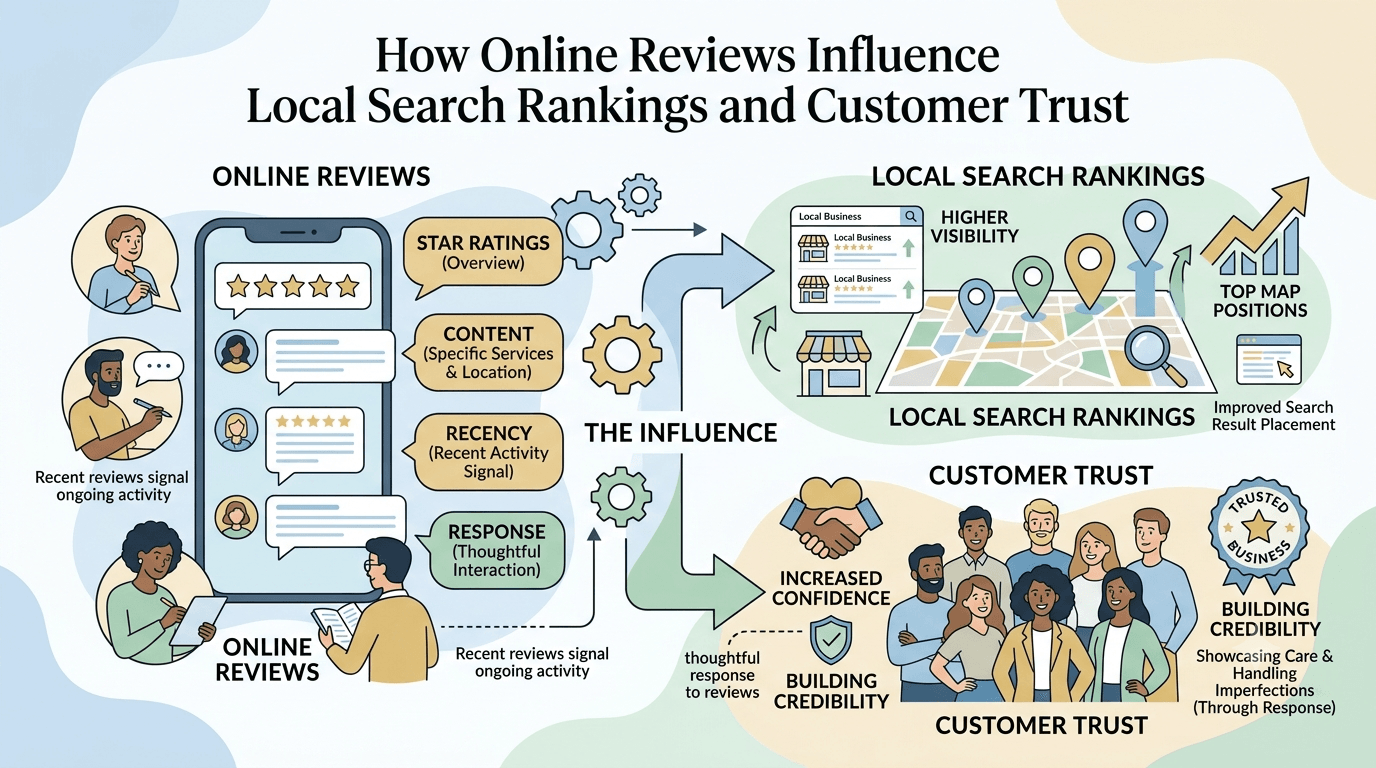
Ask any small business owner about online reviews and you’ll usually get a strong reaction, either pride over a five-star average or frustration over one unfair complaint that won’t go away. Reviews carry emotional weight because they matter, both to the humans reading them and to the search systems deciding which businesses to show first.
What Reviews Signal Beyond Star Ratings
A star rating alone tells only part of the story. The actual content of reviews, specific mentions of services, locations, and experiences, gives search engines additional context about what a business does and how well it does it.
Recency matters too. A business with a steady stream of recent reviews signals ongoing activity and relevance, while one with reviews frozen from three years ago can appear less trustworthy, even with a strong overall rating.
Why Responding to Reviews Matters as Much as Receiving Them
A thoughtful response to both positive and negative reviews shows potential customers that a real person is paying attention. It also gives a business the chance to add context, clarify a misunderstanding, or simply express genuine appreciation.
Ignoring reviews entirely, particularly negative ones, tends to raise more doubt than the negative review itself. People generally understand that no business is perfect. What they’re evaluating is how a business handles imperfection.
Encouraging Genuine Reviews Without Crossing Lines
The most effective approach is simply asking satisfied customers directly, right after a positive interaction, rather than relying on generic email blasts. Make it easy by sharing a direct link to your review page.
Reviews left on relevant local directories, like townvibelistings.com, add further credibility as well, giving potential customers additional independent confirmation beyond your Google Business Profile alone.
Conclusion
Reviews do more than reflect customer satisfaction. They actively shape how visible and trustworthy a business appears in local search, and how confident a new customer feels before ever reaching out. Treating them as an ongoing conversation, rather than a static score, tends to serve businesses far better over time.
Frequently Asked Questions
There's no strict minimum, but a steady, growing number of recent, detailed reviews tends to build more trust than a large batch collected all at once and then abandoned. Consistency over time matters more than hitting a specific total.
Always respond, calmly and professionally. A thoughtful reply to a negative review often reassures other potential customers more than the negative review itself discourages them, since it demonstrates accountability and genuine attention.
Yes, asking directly is one of the most effective and appropriate methods, as long as you're not offering incentives in exchange for positive reviews specifically, which violates most platform policies and can undermine genuine trust.
They contribute meaningfully, especially on directories relevant to your local area or industry. While Google reviews often carry the most visibility, reviews spread across multiple credible platforms reinforce overall trust and consistency.